
NOTE: The firt Guide is about blogspot while the second is about the wordpress at the end of 1st.
How to Create A Free Blogspot Website or Blog on Blogger Step by Step
What Is A Blog?
 The word popular Blogger Blogspot is also a content management platform by Google. Blogspot is also an easy service that allows you to form a blog or journal and publish it on-line like a shot. Here we have a tendency to share blogerspot Guide 2021 to begin a Blog With Complete On-Page SEO Tips & Tutorials.
Main Parts Of Blog
1. Header

- In the header there are Logo Top Manu Social Icons search bar and Main Navigation Manu. All themes have different set up whic can be customized.


4. Sides Bars

Why Do Blogging?

. To increase theirs professional ceerier
. Make money online
. Share his knowledge to other
. Business and marketing onlne
. Supporting a social cause etc.
Blogspot VS Blogger
Blogspot and Blogger bothe the ownership or products of google. But blogspot is work lik a root domain for a blog while blogger is a specepic platform. In other words we can say that blogger is a particular platform of publishing for both blogger websites and also for free blogspot.com blogs. For Blogger we can ad a custom domain but blogspot has no need of any domain. We can make money online both on blogspot and blogger.
Merits And Dimerits of Blogspot
Blogspot blogs have Also some advantages and disadvantages, Before starting blogging and setting up a blog on blogspot.com, This id neccessary to know about all that.
Merits of Blogger
Blogger is easier than WordPress an other CMS platforms to use whth customization
Lots of options for customization
Free of charges service
Faster indexing - Blogspot sites show up in Google search results within 24 hours
More opportunity to approval Google AdSense and other alternative of Adsence
custom domain can be add optionally.
Free SSL certificate.
Demerits of Blogger
Blogspot has lackage of themes and plugins while wordpress has so many themes and plugins which can easy the work of customization
Without updating your blog you can easily lose traffic.
How to Sign Up for Google Account?
You can start blogging with Blogspot, but first, you need to create a Google account.
1. Go to google.com in your web browser.
2. Click on the Sign-in button to create an account.
3. You are on the login page. If you have an account, login with your email and password, else proceed to create account. You can create a Google account for yourself or manage your business. Select an option that is right in case of you.
4. Fill out all the necessary details and click on the Next button.
5. Once the account is created, you will see a welcome message.
How to Create A Blog on Blogspot?
Creating a blogspot blog is easy but you should have some basic information about blog and blogspot. If don’t know how to set up a blog on Blogspot? Don’t worry, after reading these infomation you will be able to make your own blospot blog which may led to you further. Please read this guide carefully and do a practice with our screenshots.
1. To create a blogspot blog, open your browser google chrom and typ Blogger Sign-Up in the search bar, You will reach to blogger.com as shown below click on blogger for sign-up.

2. Click on blogger, the Sign-Up page will appear. Then Click on the (creat your blogger account button.
3. After Blogspot sign-Up You should Sin-in again you will reach on the Blogger dashboard. On the top lift side, the Create blog option is given to you.

5. As you click on the Create blog option, you get a title box to choose a name for your blog. Enter the name of your new blog and click on the Next button. If you need help choosing a name for your blog, your blog name should be on keyword research bas on, Some name are not avaliable becaus that have already taken so you will find another one which is avaliable, you enter that blog name.

7. Congrats, you have successfully created a blogspot blog.

How to Change A Theme on Blogspot?
1. Click on the Theme menu item on the left side menu list. You see, the default theme is Contempo Light. You may change the Blogger theme at any time.

2. Just scroll down to choose the theme of your choice from the many available options. There are so many Blogspot themes, but we highly recommend using Contempo, Soho, Emporio, Notable, or Essential only. These themes are very fast. You can use Google’s PageSpeed Insight to check the loading speed and other issues. You get an option to preview the theme before applying.
You should take a backup of the existing blog theme before applying a new theme.

3. You need to click on the Apply button to use the selected theme.
You can also buy premium themes for blogspot blog for beautiful design and customizations. Here’s our guide on how to install a blogger theme. You should also know the basics of Blogger’s HTML editor.
Is Your Blog Visible to Search Engines?
1. Click on the Settings menu item on the left sidebar.
2. Scroll your page to the Privacy section.
3. Double check the toggle button should be green.

We recommend learning about Blogspot / Blogger SEO. You can customize the robots.txt header tags and robots.txt if you are an advanced user.
How to Upload A Logo on Blogspot Blog?
1. Click on the Layout menu item on the left side.
2. In the Header section, click on the edit pencil.

3. You can either choose a file from your computer or paste an image URL to upload a logo on your blog. You also have three options for logo placement; select the right for you.
Behind title and description
Behind title and description
Have a description placed after the image
You can also tick the Shrink to fit option if the logo is bigger than the header.

4. Click on the Save button to make changes.
Similar to a logo, a favicon also helps your blog to get identified among other blogs. You can also add a favicon on Blogspot blogs.
How to Add A Gadget on Blogspot?
1. Click on the Layout menu item on the left menu list.
2. Under the sidebar top or bottom, click on Add a Gadget.
3. In the pop-up window, scroll down to see available gadgets. Click on the name of Gadget or + icon to add a new gadget to your blog.
4. Update your gadget with the required information.
5. Click on the Save button, the gadget will be added to the sidebar.
How to Publish A Blog Post on Blogspot?
Publishing a blog post consists of different tasks. Hereunder we are discussing a few of them.
Compose a new post
Click the New Post button to create a new post.

The blog post editor and toolbar
A post editor will open. Post editor has HTML view and Compose view. Click on the pencil icon on the composer toolbar to get these options. I recommend the compose view for beginners.

It has different sets of options-
Toggle between HTML view and Compose view
Undo and Redo
Font type, font size, headings, and paragraph
Bold, italics, underline, strikethrough, text color, and text background color
Insert or edit links, insert image, insert video, and insert special characters
Text alignment, increase indent, and decrease indent
Bulleted list, numbered list, quoted text, and insert jump break
Left to right layout, right to left layout, and input tools
Clear formatting
Add content to a blog post
Enter your blog post title, article, and add images just like you do with a word processing tool.

Insert an image to a blog post
1. Place the cursor at the spot where you want the image in a blog post.
2. Click on the image icon in the toolbar.
3. You get four options to add an image to your blog post.
Upload from computer
Photos
Blogger
By URL
If you are uploading images from your computer, click on the Choose files and select the required image file.

4. Click on the uploaded image to enter the Select button.
The required image will be added to your blog post.
Insert a link to a blog post
1. First, copy an internal or external URL to add.
2. Select a text to an internal or external URL to it.
3. Click on the link icon given on the composer toolbar.
4. An option to paste or search for a link will appear. Paste the copied URL in the given box.

5. You get two options advance options.
Open this link in a new window
Add ‘rel = nofollow’ attribute
You may use the first one without hesitation, but don’t use it if you don’t know anything about a nofollow tag.
6. Click on the Apply button. A link has been added to your blog post.
You can edit this added link, buy click on the same text highlighted in blue color.
Embed YouTube videos to a blog post
1. Click on the Insert video icon on the given composer toolbar.
2. Drop-down will show the YouTube option. Click on it.
3. You get two options to add a video - Uploads and Search. Select the Search tab.
4. A search box to search Youtube videos. Search a video and hit the magnifying glass button
5. Select a video from the populated list.

6. Click on the Select button. This video will be added to your video.
Add labels to a blog post
You can add labels to your blog post. The label is another term for category or tag for your post. These labels show on the blog post. When a reader clicks on a label, all posts with that label will be on a page. Blogger has a label gadget that you can add to your blog sidebar. It will help your readers to read all posts that are published under the same label.
1. You can add Labels from the Post settings given on the right sidebar.
2. Click on the Labels option. A box will appear to add labels.
3. Enter labels related to the post.

Great, you have done it perfectly.
Edit permalink of a blog post
1. You can tweak your blog post permalink. This option is given under the Post settings.
2. Click on the Permalink option. It shows two options- automatic permalink and custom permalink.
3. You can use the custom permalink option to keep your blog post URL short and user-friendly.
Preview and publish a blog post
You can see the preview of your blog post before publishing it. You can do so by clicking on the Preview button in the top right corner.
If the post preview looks perfect, then you can click on the Publish button.

How to Publish A Page on Blogspot?
Blogspot gives you options to add pages to your blog. You can publish a page on blogspot. You can create different types of pages like about me, contact us, privacy, disclaimer, etc.
1. Click on the Pages menu item on the left side menu list.
2. Then click on the New Page.

3. Enter the page title.
4. Add content for the page.
5. You may disable reader comments on the pages.

6. Preview and publish your page.
Do You Use Blogspot?
You have gone through our tutorial on how to create a blog on Blogspot, and now you can start blogging. Blogspot is one of the simple and free blogging platforms to create a blog for free. Everyone can create and set up a blog without any expertise. If you still have any questions in your mind, please leave a comment.
--------------------------------------------------------------------------------------------------------------------------------------------
WordPress A-Z Guide for beginners 2021
What is WordPress ?
Wordpress is World top CMS Service.

After finding out the massive number of users WordPress has, it may leave you wondering, why is it so popular?
A mixture of several factors should be taken into account. The general viewpoint is that WordPress is a simple blogging tool, however, it is much more than that.
Due to the fact that Wordpress is free and an open source project, it allows anyone to improve and edit its code according to one’s liking. It also features thousands of free plugins, themes, widgets, and other tools.
All these features allow you to create any type of website, starting from simple blogs, personal websites or portfolios, ranging to e-shops, knowledge bases or job boards.
Another factor is that WordPress is completely free and supports all hosting platforms with PHP and MySQL. On top of that, this CMS is constantly updated with new versions that improve security, include new features and improve overall performance.
Last, but not least, WordPress has a huge community with dedicated forums and discussions all over the internet. The amount of data that is available and thousands of WordPress tutorials also make WordPress one of the easiest to use content management systems out there.
What is a CMS?
A content management system or CMS for short is an application with the ability to create, modify and publish digital content. In most cases, it also supports multiple users, allowing them to work in collaboration.
For example, in WordPress it is possible to create several administrative users, each one having different privileges. Content management systems also include text and formatting features, the ability to upload videos, photos, audio, maps or even your own code.
A content management system consists of two major components:
- A content management application (CMA). The CMA can be referred to as the graphical user interface (GUI) that lets a user create, modify, remove and publish content without ever needing to have knowledge of HTML or programming languages.
- A content delivery application (CDA). The CDA is responsible for the back-end services that manage and deliver content after it is in the CMA.
Other features worth mentioning are:
- SEO-friendly URLs
- Online support and communities
- User/group functions
- Various templates and designs
- Installation wizards and upgrades/updates
The three most popular content management systems in the world are WordPress, Joomla, and Drupal.
WordPress.com vs. WordPress.org
WordPress.com and WordPress.org are two ways of hosting a WordPress site.
The thing that varies with these two methods is the actual host. By using WordPress.org, you may download the script free of charge and host it yourself on a local machine or with a hosting provider (such as Hostinger).
On the other hand, WordPress.com takes care of all that by hosting the site for you. You don’t have to manage a web server, pay for hosting or download software, however, ads are shown on your site.
Both WordPress.org and WordPress.com have certain pros and cons.
If you are not interested in having your own hosting or managing a web server, then WordPress.com may be the way to go.
It is free and can be quickly set up. You will also have various features and options for your site’s customization.
However, it comes with downsides. Your website will include WordPress.com in the URL and you will not be able to upload custom themes or plugins.
The ability to edit or modify PHP code behind your site will also not be possible.
Using a self-hosted version from WordPress.org provides more flexibility and control over your site. You will be able to use your own domain name, upload themes, plugins and install them.
You will also have access to your WordPress files, database, and code, meaning that you will be able to modify it according to your liking. The most popular and powerful WordPress sites are self-hosted, as it provides greater flexibility and the ability to implement custom functionality, code, and designs.
Last but not least, in case WordPress is not the CMS for you, having your own hosting account will allow you to test other content management systems such as Drupal or Joomla.
This WordPress tutorial will focus on the self-hosted WordPress version.
Step 1 – Installing WordPress
One reason for WordPress popularity is the low system requirements needed to run this CMS on a web server:
- PHP version 5.2.4 or greater.
- MySQL version 5.0.15 or greater or any version of MariaDB.
You would probably have to search for a hosting provider which lacks WordPress support. Many hosts use various auto-installers to make the WordPress installation process as simple as possible.
By using auto-installers, users no longer have to deal with database creation or file uploading.
In this part of our WordPress tutorial, you will learn two different ways to install WordPress.
Before proceeding with WordPress installation, you need to decide on how you want to access your website. Do you want WordPress on your domain name root (example.com), subfolder (example.com/blog) or subdomain name (blog.example.com)? Only if you want to setup WordPress on a subdomain name, you will have to take an additional step and create a subdomain name. On Hostinger this can be easily done in the Subdomains section.
Option 1.1 – Installing WordPress on Hostinger by Using Auto Installer
Let’s start with the simplest and fastest way to install WordPress – Hostinger auto installer. The steps below show how to install WordPress on Hostinger control panel:
- Access Hostinger control panel.
- Locate Auto Installer and open it.
- Enter WordPress in the search field and click on its icon.
- Now fill in website details:
- URL – The URL where WordPress should be installed. If you want to install it on root domain name (example.com) then leave it empty.
- Language – Choose WordPress language.
- Administrator Username – Your WordPress admin username. You will use it to access WordPress admin area.
- Administrator Password – Your WordPress admin password. You will use it to access WordPress admin area.
- Administrator Email – Enter your email address.
- Website Title – The title of your WordPress website.
- Website Tagline – A short sentence or slogan explaining what your website is about.
- Press Install button.
Option 1.2 – Installing WordPress Manually
If you want to understand the basics and learn how WordPress works, you can install it manually. WordPress is famous for its 5-minute installer.
The process is straightforward and similar to any other software installation. So if you have ever installed any computer program – it won’t be hard for you to complete the WordPress installation.
What you need before proceeding:
- FTP client or File Manager
- Latest Version of WordPress
 First of all, download the latest WordPress from the official WordPress.org website.
Once the download is complete, you can start uploading WordPress files to your hosting account. You can use either a File Manager provided by your hosting provider, or an FTP client.
There is no difference which tool you will use to upload WordPress files, besides ease-of-use. The only thing that you should take into account is the destination directory.
For example, if you want to have WordPress on a root domain name, files should be uploaded to the public_html folder; if you want to serve WordPress from a subdomain name or a subfolder, upload the files to the appropriate directory.

WordPress stores information in the database. Thus, it’s mandatory to create one. On Hostinger, a new database can be created in the MySQL Databases section. Be sure to write down the database details as you will need them later.
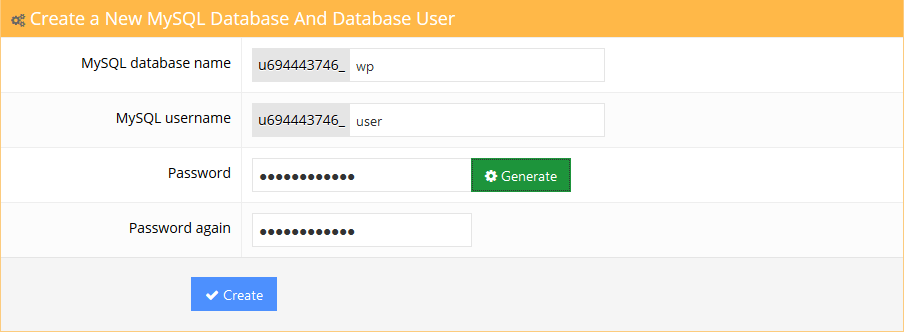
Now visit your domain name in order to start the installation process. You’ll be asked to fill in the MySQL database information, administrator details and the site information.
For more detailed instructions, see the tutorial on how to install WordPress on different hosting control panels. In order to find out how to migrate WordPress, see this tutorial.
Step 2 – Navigating in WordPress Dashboard
Once the installation is complete, the first thing you would want to do is log in to the WordPress administrator dashboard.
Usually, there is a link to the login page on the front end of WordPress blog. However, some themes don’t have this link. In this case, the easiest way to log in to WordPress is by adding wp-admin at the end of your website’s address like this:
http://www.yourdomain.com/wp-admin
This URL will direct you to the login screen where you will be asked to enter the administrator’s username and password. Remember, you have entered these details during WordPress installation. If you have forgotten your password, click on the Lost your password? link.
More detailed instructions on how to login to WordPress can be found here.

after enter in at the admin panel, The administrator dashboard will appeared. This is the over veive to give you all option to create a beautiful website within three main component.
A toolbar at the highest bar of the page. It contains links to the foremost ordinarily used body functions and resources. for instance, if you hover over your website’s name, you may get a link to the general public read of your website. It additionally displays straightforward notifications like updates and new comments count.
The main navigation menu on the left-side. It contains links to any or all any or all body screens of WordPress. If you hover over a menu item, a sub-menu with further things are going to be displayed.
The main process aria .
The first time you log in to the WordPress admin panel, you may see a welcome module that contains some helpful links to assist you start.
Once you are snug with the dashboard, press the Dismiss button therefore on cowl this module.
Other Modules:
At a glance box will tell you a to the approach many posts, pages and comments you've. It in addition shows WordPress version and theme you are running.
Activity box provides you slightly further knowledge regarding your latest posts and comments. It shows the standing of all comments and a quick list of the foremost recent comments..
Quick Draft box. moving into content into this box will begin a replacement diary post. However, you cannot publish one from here as this box is just for taking diary posts ideas for you to return back back to late.
WordPress News. This module displays the most recent WordPress news.
Each of those windows has very little arrows that you'll be able to use to quickly hide the box. you'll be able to additionally drag and drop them to completely different positions.
Step three – post or content publication
Creating a web site with WordPress starts with post or content publication or a brand new page. you may suppose – what is the distinction between posts and pages?
The answer is easy. WordPress posts is also categorized, tagged, archived. WordPress posts ar accustomed publish time-sensitive content.
In distinction, pages area unit chiefly for static, dateless content. They don’t have completely different classes or tags. Contact U.S.A. or concerning pages and privacy policy area unit sensible samples of pages.
Step 3.1 – writing a brand new Post
To create or judicial writ a brand new WordPress post open the Add New section beneath Posts or select New -> Post chance from the highest toolbar.
You will be given with associate screen with AN array of posting options. the primary task you must do is enter a title for your post.
Secondly, enter the actual content of your post within the field below. If you would like to format your text, use the toolbar decisions.
It’s identical because the one you will notice in MS Word or the opposite trendy text editor.
At the right-hand side of the screen, you will see the questionable meta-boxes. each box incorporates a particular perform
Publish. Here you'll be able to modification the standing and visibility of your post, schedule it. By clicking the Publish button your post will go live. If you opt to delete the post, press the Move to Trash button.
Categories. On this box, you'll be able to assign your post to a specific class.you'll even turn out a replacement one by pressing the + Add New category button.
Tags box permits to quickly add new tags.
Featured Image. Here you may assign a featured image to a post. it'll be visible at the terribly high of the post (image location is also all completely different counting on theme)
Step 3.2 – Creating a New Page
In order to create a new page on wordpress, click at the Add New section under Pages menu or click New -> Page button at the top bar of tools
Add New Put your page name somethink like this Home, about, contact us. section has identical.
You may also notice that Pages section does not have Tags and Categories meta-boxes. Instead, it has a box called Page Attributes.
You can can creat create a page or so many many and also creat parent pages in the shape of dropdown manu in this section.This is useful way to create pages pages submanu if you want work on several pages under one parent page.
Step 4th – Installing WordPress plugins
The main purpose of installing wordpress plugin is to make easier the function of creating a websit or expand WordPress functionality. Just by installing and activating plugins you ca increase the features to create a beautiful WordPress site without any coding.
The CMS of wordpres has a lots of free and paid plugins whic developers have created for different purpose, that's why WP called the world's top popular cms syestem. Thus, you can surely find a plugin that fits accordinglly you needs.
How to to install plugins
Installing plugins is an easy task both for a beginner and wordpress experts.There are thousand of Free and freemium plugins are available on WordPress.org plugin directory.
The installation process of plugins is the same to installing a awordpress theme.
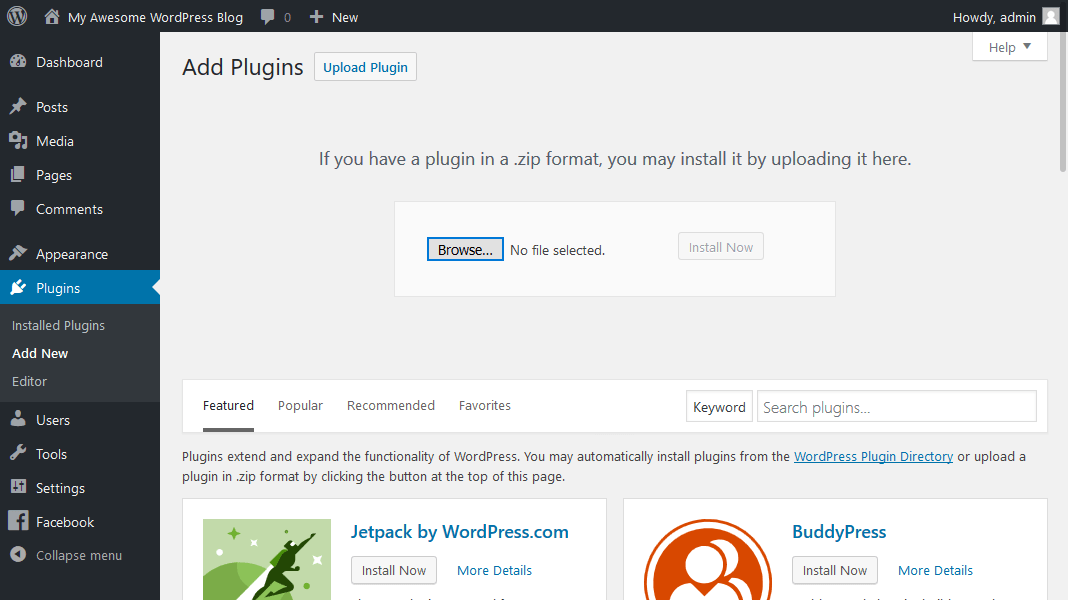
To install a WordPress plugin go to the wpress dashboard click on Plugin then Add New under Plugins and write the name of the plugin you want to install in the search bar. Click Install and then Activate button.
If you want to use a premium whic you have purchased from WP plugins Directory, it can be also add maually by uploading it's zip file.
Theme installation is too easy cick plugin Add New button under Plugins and hit Upload Plugin. Now select a plugin where you have saved in your pc and upload it. Finally, install and activate the plugin. If you need a detailed guide, see this tutorial
Essential WordPress Plugins
There are so many WordPress plugins – it could be hard to choose the right one. In fact, many of the plugins serve the same purpose, for example, there are dozens of WordPress caching plugins.
That is why we decided to list the best WordPress plugins that are essential for every WordPress blog.
- Google XML Sitemaps. This plugin has the funtionality to generate XML- sitemaps automatically of your your website for search engine.
- Yoast SEO. Probably the most popular YastSEO plugin of WordPress will help you improve the search engine optimization. From meta tags to writing suggestions. Yoast SEO plugin is one of the best plugin regarding SEO.
- Wordfence Security. This plugin will keep your WP site safe and secure from hackers and malware. It has firewall and malware.
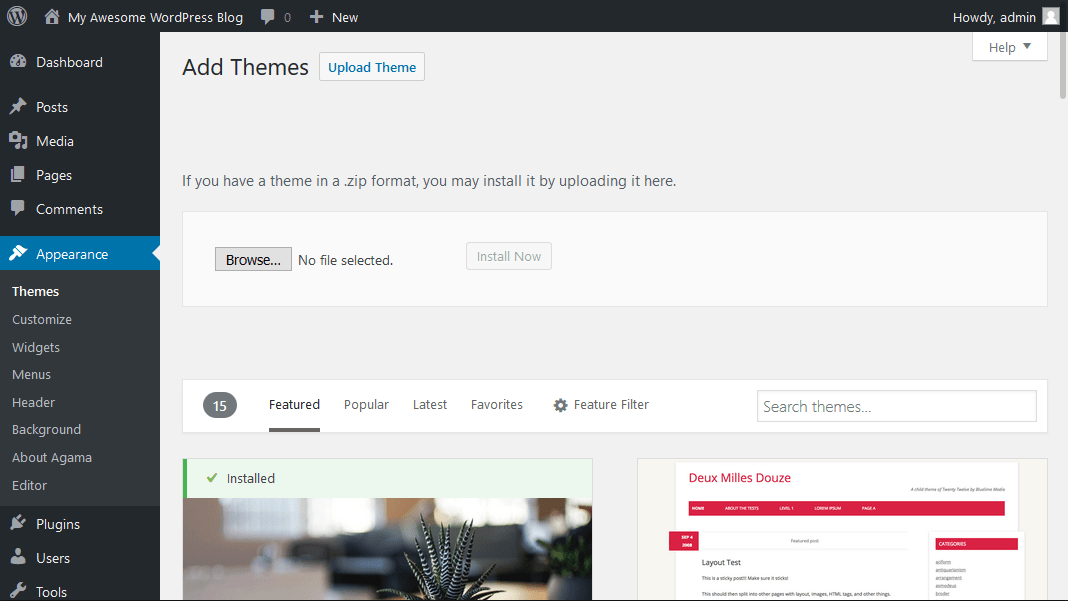
- Contact kind seven. easy however terribly powerful WordPress contact kind plugin. produce any contact or perhaps lead generation forms with this plugin. It’s not suggested to clog Wordpress with dozens of plugins because it will decrease site’s performance. Keep your WordPress clean by putting in solely essential plugins and delete those you're not victimization. Step five - putting in WordPress Themes The look of WordPress website may be modified by applying themes. There area unit free and premium WordPress themes. a number of them area unit universal and may be used on any web site. Others area unit engineered for a really specific purpose, for instance, the e-commerce themes. WordPress created theme installation super straightforward. It virtually takes simply many minutes to put in free WordPress themes. In order to proceed, access the looks section and rummage around for a pleasant wanting theme. you'll even filter themes by options or colors. Theme preview feature helps you to see however your web site can look with a specific theme. This is often helpful, because it can save it slow - you may not have to be compelled to install multiple themes simply to search out the theme that matches your desires. The higher than technique is appropriate for gratis and premium themes solely. What if you bought a pleasant wanting premium theme? During this case, you may have to be compelled to transfer the theme files manually. Access identical look section, press the transfer Theme button and choose the theme’s .zip file. It will take up to several minutes for the uploading method to finish. Once it's done, simply activate the theme. want precise steps? See a comprehensive tutorial on a way to install themes.------------


0 Comments